

By DJ Swifty | PCB Radio
When you tune into the station, you hear the music, the chat, and the energy. But when the mic goes dead and the music stops, a completely different track starts playing in my head. It’s a track driven by a rhythm I can’t control: tremors, falls, and a hell of a lot of fear.
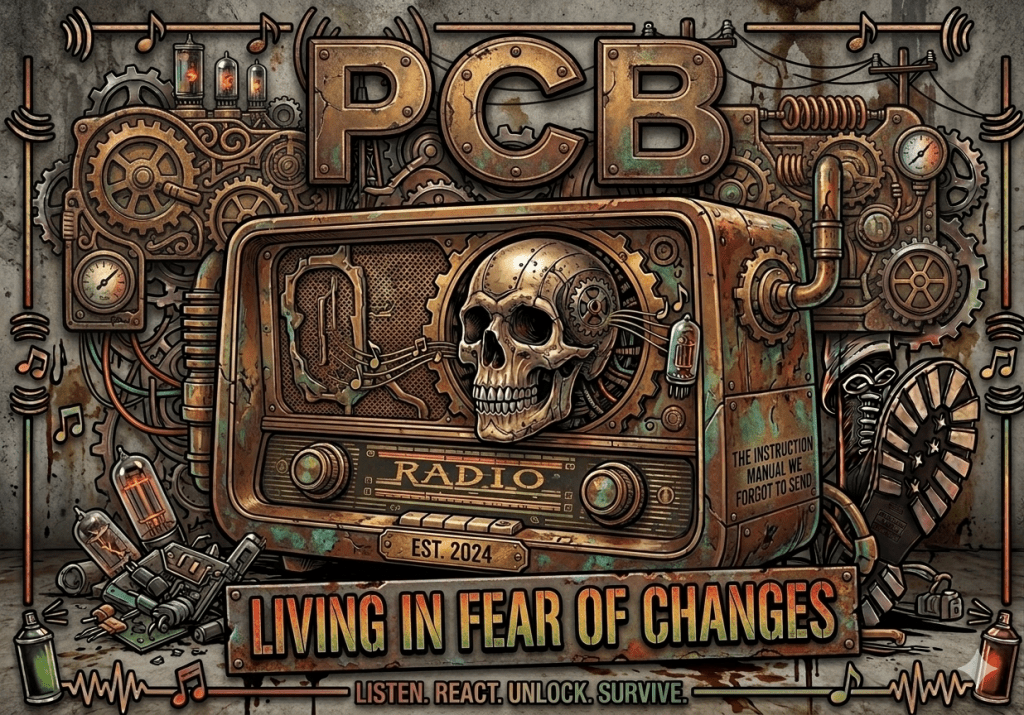
Lately, my body feels less like a home and more like a piece of flat-pack furniture delivered with half the pieces missing and absolutely no instructions.
Every single week, I get what I call “add-ons.” A new tremor here. A sudden weakness there. A new physical glitch that just shows up out of the blue and takes over. And the worst part? There’s no manual. No leaflet to tell me: “This tremor will last for twenty minutes,” or “This weakness is your new normal.” I’m just left standing there—or worse, falling down—trying to figure out the rules of a game that keeps changing.
The Daily Drop
Let’s talk about the falls, because they happen daily now.
When you fall that often, the world changes shape. You don’t just see a room, a hallway, or a garden path anymore; you see a minefield. Your brain is constantly scanning, calculating, and panicking. If I go over right here, what am I going to hit? Is that edge sharp? Am I going to land badly?
It is exhausting. It’s a constant, high-alert survival mode that leaves every single muscle in my body tight, tired, and aching. By the time I actually hit the floor, my brain has already run through a hundred worst-case scenarios.
The “What If” Silence
But the scariest part isn’t even the impact. It’s the silence right after, or the panic right before.
It’s the fear of going down and realizing you’re stuck. The vulnerability of looking around and wondering: Can anyone hear me? Is anyone close enough to help? That fear is a cage. It tempts you to just stay in one place and never move, because moving feels like taking your life into your own hands. It shrinks your world down until you feel entirely isolated, even when people are right in the next room.
We live in a world obsessed with answers. We want scans to show us a neat little picture of what’s wrong so we can fix it. But when the scans show nothing, and the symptoms keep piling up anyway, you start to feel like you’re losing your mind.
I’m writing this because I know I’m not the only one fighting an invisible battle. Every part of my body feels the weight of this right now. But naming the fear, putting it out there on paper, and sharing it with you all on PCB Radio—that’s my way of taking a little bit of the power back.
We might not have the instruction manual, but we’re still here, figuring it out one day at a time.
 Pcbradio.com
You must be logged in to post a comment.